One blackout cost on the order of a year of capacity payments
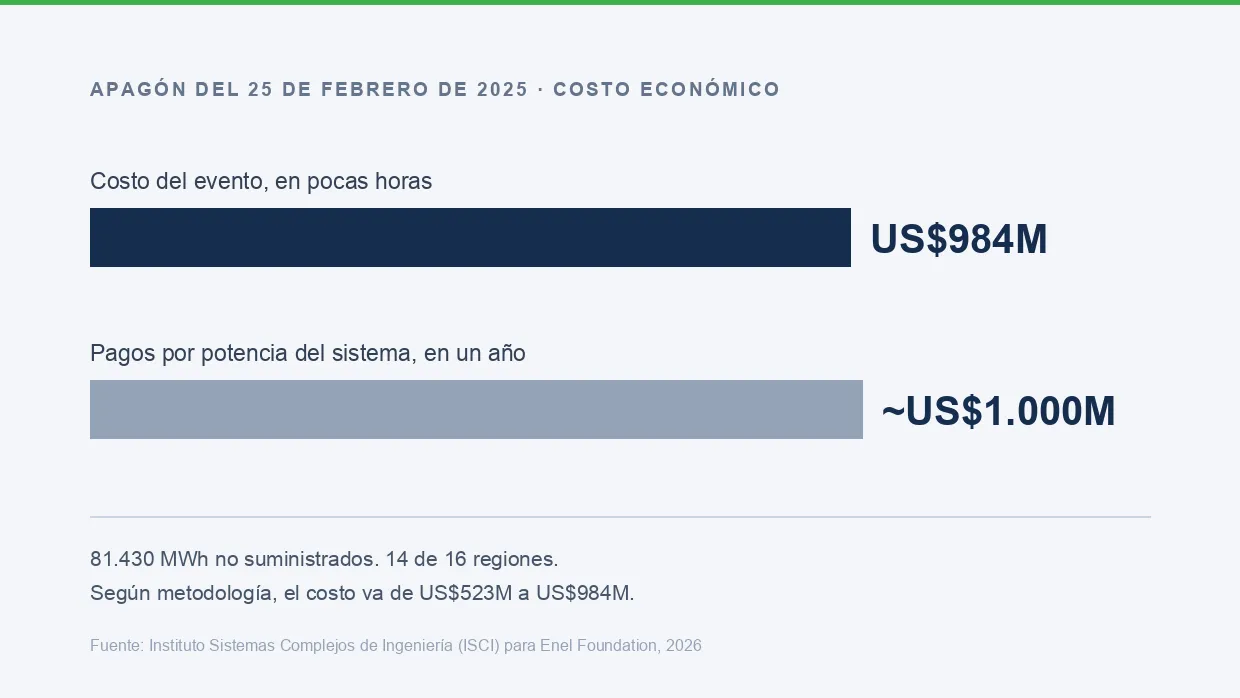
The ISCI study on Chile's February 2025 blackout puts its economic cost at up to US$984 million — the same order of magnitude as what the system pays for capacity in a year. The study itself points to where the asymmetry lies.
On February 25, 2025, a blackout cut supply to 14 of Chile’s 16 regions and 98.5% of the population, according to Chile’s electricity and fuels regulator (Superintendencia de Electricidad y Combustibles, SEC). Some 81,430 MWh went unserved.
A study by the Instituto Sistemas Complejos de Ingeniería (ISCI), commissioned by Enel Foundation and released in July 2026, puts the economic cost of those hours at up to US$984 million. Depending on the valuation methodology applied, the range runs from US$523 million to US$984 million.
For scale, the report makes the comparison itself: a cost of that magnitude is comparable to the Chilean system’s annual capacity payments, close to US$1 billion a year.
A year of instruments, a few hours of event
Capacity payments are the structural mechanism through which a system secures available capacity for when it is needed. They are a permanent, budgeted expense, paid every year.
The study’s conclusion is that a low-probability, high-impact event can destroy, in a matter of hours, economic value on the order of a full year of those instruments.
This is not an argument about whether capacity payments work. It is an argument about what falls outside them.
The asymmetry the study identifies
The report puts it plainly: while regulation explicitly internalizes the cost of resource adequacy, the systemic risks tied to resilience are handled “implicitly, in fragmented fashion, and after the fact.”
That distinction is the heart of the matter. Adequacy and resilience answer different questions:
- Adequacy is having enough capacity to serve demand. Chile has paid for it for two decades through firm capacity (potencia de suficiencia), regulated under Supreme Decree 62/2006.
- Resilience is the system’s ability to withstand a severe event and recover quickly. It has no equivalent instrument compensating it.
The study concludes that this regulatory asymmetry weakens incentives to invest in resilience, particularly in distribution networks. Carried over to generation and storage, the practical effect is the same: anyone assessing an asset whose main contribution is robustness against extreme events finds no revenue stream paying for that attribute.
The instrument exists in other jurisdictions
Over recent months, two European frameworks moved to give long-term contracts — and with them bankability — to investments of this kind:
- Germany opened its first capacity auction under the StromVKG law: 4.5 GW over 15 years, capped at €244,000 per MW-year of de-rated capacity. The bidding window closes in September 2026.
- United Kingdom — through Ofgem, its energy regulator — provisionally selected 16 projects (7.6 GW and 136.9 GWh of long-duration storage) in the first window of its cap-and-floor scheme.
The common element isn’t subsidy — it’s tenor: contracts long enough to make an asset financeable when its returns depend on infrequent events.
Meanwhile, private capital moves at its own pace
In July 2026 a 450 MW / 3,600 MWh pumped-storage project entered Chile’s environmental assessment system, with estimated investment of US$900 million and commissioning projected for 2032.
The capital is available and arrives with a long horizon. It arrives, however, on the timeline its own risk tolerance allows.
The ISCI’s recommendation is to incorporate systemic resilience explicitly into system planning and regulation. Debate on adequacy tends to concentrate on how much capacity gets built; the study suggests a second question is open — which attributes of the system currently have anyone paying for them.