Batteries on Chile's distribution grid: the pending standard will decide when they can charge
Chile's new small-scale generation regulation lets storage charge from the distribution grid. The technical standard in force forbids it, and connections are on hold. What remains to be written is the battery's priority behind end customers, and with it, the business case.
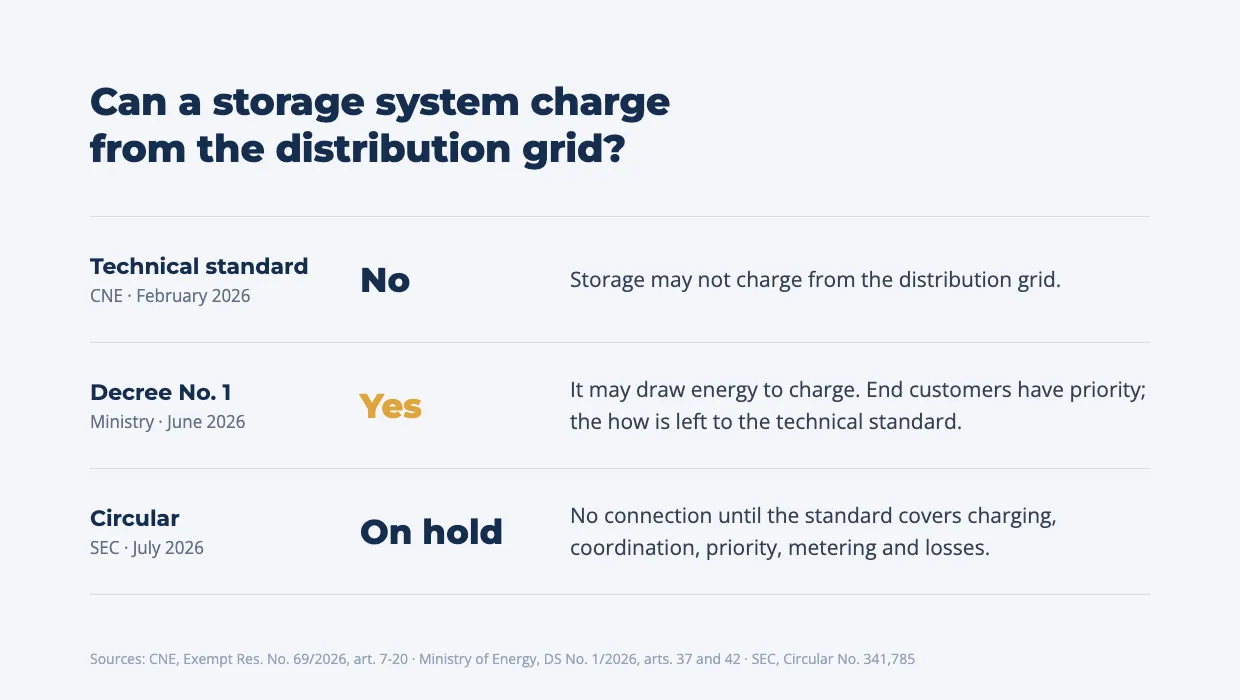
In June, a decree said a storage system may charge from the distribution grid. Since February, a technical standard has said it may not. Between the two, since July, Chile’s electricity and fuels regulator (Superintendencia de Electricidad y Combustibles, SEC) has put stand-alone battery connections on hold.
The open question is no longer whether storage gets onto the distribution grid. It is how storage shares that grid’s capacity with the customers already on it, and whether anyone will recognize what it can contribute. Both answers will be written as technical procedure, and both will set the business case.
Three instruments, three answers
| Instrument | In force since | On charging from the distribution grid |
|---|---|---|
| Technical standard for connecting and operating small distributed generators on medium-voltage networks (CNE Exempt Resolution No. 69) | Official Gazette, February 19, 2026 | A distributed generator with a storage component may not charge it from the distribution grid (art. 7-20) |
| Supreme Decree No. 1 of 2026, Ministry of Energy | Official Gazette, June 13, 2026 | Charging withdrawals are allowed. The distribution company must give end customers’ withdrawals priority, and the technical standard sets how (arts. 37 and 42) |
| SEC Circular No. 341,785 | July 14, 2026 | Stand-alone storage may not start or continue grid connection until the standard covers the pending matters |
The decree amended the regulation governing small distributed generators (known in Chile as PMGD), now titled the Regulation for Small-Scale Generation and Storage Systems, and extended it to storage systems with net output of up to 9,000 kW. In doing so it created a new category on the distribution grid: a project made up only of storage, which draws energy from the grid to charge and injects it later.
The decree also settled how those withdrawals are treated economically. They are valued under the pricing regime the project opts into (art. 9 bis) and are exempt from end-customer charges (art. 9 ter). What it left pending is operation.
The technical standard meant to make that operation possible predates the decree and says the opposite. Its article 7-20 provides that “a PMGD with a storage component may not charge its storage component from the distribution grid,” and requires automated controls that prevent it within two seconds. The standard only covers storage as part of a generating plant, injecting within authorized time blocks.
The SEC drew the practical conclusion. Without a technical procedure, there is no connection to process.
The five matters the standard must resolve
According to the SEC circular, these are the matters that must be regulated before these projects can proceed:
- Procedures for drawing energy from the grid and charging.
- Coordination of those withdrawals with the distribution company.
- Priority of supply to end customers.
- Metering and recording requirements to tell charging withdrawals apart from consumption.
- The methodology for allocating electrical losses.
The first four are exactly what the decree itself assigned to the technical standard (art. 42, items k, l and n). All are technical in form, and at least three bear directly on a project’s cash flows. Priority determines under what conditions a battery may charge when a feeder’s capacity is not enough for everyone. Metering determines which withdrawals count as storage charging and which as consumption. Losses are a cost the methodology will assign to someone.
For an asset whose revenue depends on charging at some hours and injecting at others, the priority rule is part of the cash flow.
What has moved since July
- July. The renewables and storage trade association (ACERA) welcomed the clarity the circular brought to the new framework, but said it was concerned “that the lack of this technical regulation will, in practice, prevent progress in connecting stand-alone BESS projects under the PMGD regime.”
- September. The independent generators’ trade association (Generadores Independientes de Energía, GIE) announced on September 14 that it had put two measures to the Minister of Energy, copying the SEC, the CNE and the chair of the lower house’s Mining and Energy Committee: an SEC circular with interim technical criteria, and a targeted update to the technical standard. Citing industry estimates, the association puts projects of this kind at around 500 MW in various stages of development, with associated investment of close to US$450 million.
- The rulemaking calendar. The 2026 Annual Rulemaking Plan of the National Energy Commission (CNE), approved in December 2025, states that amending the technical standard to reflect the regulation’s changes “will begin once the regulatory amendment is published.” The decree was published on June 13. As of October 8, we found no start resolution or public consultation for that amendment on the CNE’s website. The same plan allows the Commission to modify it “for urgent reasons or manifest need.”
No authority has published a deadline.
Grid user or grid resource
The framework and the industry look at the same asset from two vantage points.
The decree emphasizes grid use. It guarantees distributed generators access to the distribution grid “to the extent that the PMGD’s operation does not degrade the security, quality and continuity of service.” And it requires the distribution company to give end customers’ withdrawals priority over withdrawals to charge storage, “in order to comply with the obligations established by Law” (art. 37).
The association emphasizes what storage can bring to the distribution grid: bringing its benefits closer to the grids and their users, as a complement to the growth of batteries connected to the transmission system.
The two views collide less than it seems, because end-customer priority only kicks in when a feeder’s capacity is not enough for everyone. How often that happens depends on two curves: when the battery charges, and when the feeder consumes.
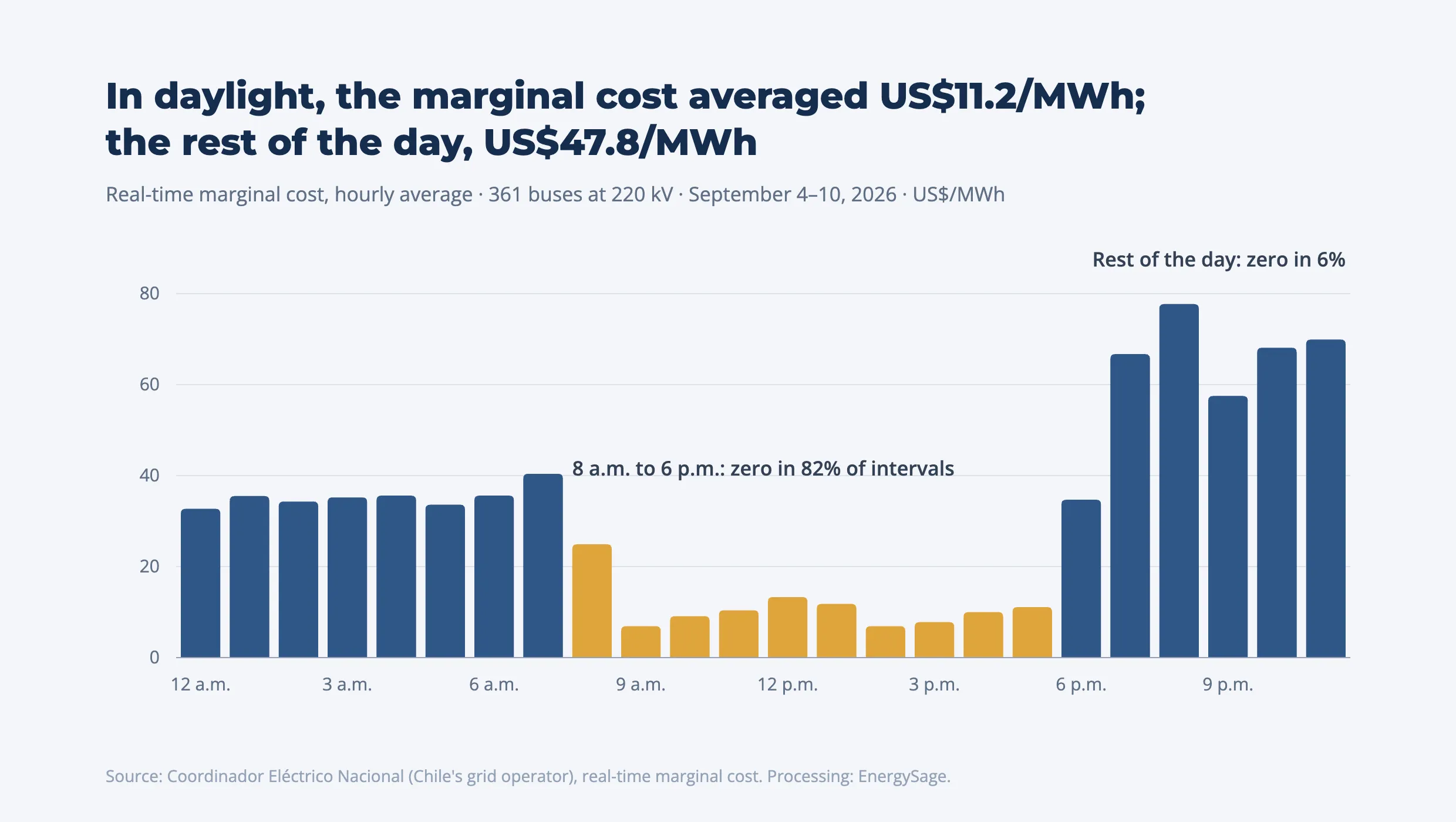
Price sets the first. In the week of September 4 to 10, between 8 a.m. and 6 p.m., the real-time marginal cost averaged US$11.2/MWh across the system’s 361 buses at 220 kV and was zero in 82% of intervals. The rest of the day averaged US$47.8/MWh and was zero in only 6%. A battery chasing that spread charges in daylight and injects in the late afternoon and at night.
The second depends on the feeder. On a mostly residential one, consumption tends to be lower during daylight hours, when many homes are empty, and rises in the evening. There, the battery’s charging window and the grid’s most demanding hours do not overlap, and the battery injects when the feeder consumes most. On feeders with daytime commercial, industrial or agricultural load, they can overlap.
The priority rule, then, will not weigh the same on every feeder. The feeder a project connects to becomes a variable in its assessment.
That week’s marginal cost series was delivered to clients in our Weekly Grid Report of September 11, 2026.
What the standard already allows, and what it does not say
The framework under discussion treats stand-alone storage as a user of the distribution grid: how it draws energy, with what priority, how it is metered and what losses it bears. The reverse, what a battery can contribute to supply quality for the users on its feeder, has only one route in the standard today.
Article 7-26 of the technical standard in force allows the distribution company to agree with the operator of a distributed generator on “island operation” during scheduled, agreed, coordinated or studied supply interruptions, under an agreement that ensures appropriate supply quality for users. It is a case-by-case arrangement, limited to scheduled interruptions, and the standard does not say how that contribution is valued. In an unintentional island, by contrast, the generator must disconnect.
This gap is not unique to storage. The study by the Instituto Sistemas Complejos de Ingeniería (ISCI) on Chile’s February 2025 blackout, released in July 2026, concludes that regulation explicitly internalizes the cost of capacity adequacy, while resilience risks are handled “implicitly, in a fragmented way and after the fact.” According to the study, that asymmetry leaves too little incentive to invest in resilience, particularly in distribution networks.
Whether the update will extend the article 7-26 route to stand-alone storage, or recognize in some other way what a battery contributes to its feeder, is a question no public document takes up yet. For now, the framework treats the battery as a load to be scheduled.
What comes next: two paths, two designs and an open calendar
The interim path. This is what the association proposed, and the SEC has used it with distribution-connected storage before. In 2024, Circular No. 232,140 set guidelines for assessing distributed generators with storage that operate in time blocks. In 2025, Circular No. 290,539 strengthened the criteria for assessing their effect on congestion in zonal networks. Both concern storage paired with generation, not stand-alone storage.
The definitive path. Amending the technical standard goes through the CNE’s rulemaking procedure, which the annual plan made conditional on the decree’s publication. It has no published date.
The two paths are not mutually exclusive. Interim criteria allow connections to be processed; the standard sets the conditions under which those assets will operate over their useful life. A project connected under the first will be subject to what the second says.
Two ways to enforce priority. Either path will have to decide how the battery’s withdrawals are ranked against the end customer’s. One option is time windows set in advance. That is the logic the current standard already applies to storage paired with distributed generators, which inject within the time blocks set in their connection criteria report, on a schedule fixed by the distribution company. Another is grid-use or congestion signals, issued by the distribution company according to the state of each feeder and complied with by the distributed generator itself, which self-dispatches. The first restricts by the clock; the second, by the actual condition of the grid. For a project, under the first the restriction enters the model as a given; under the second, as a variable that depends on its feeder.
What changes for anyone assessing a project today
A distribution-connected battery assessed only on the spread between hourly prices answers part of the question. The other part is regulatory and not yet written: how many hours it will be able to charge when the feeder is under strain, how its withdrawals will be metered, what losses will be assigned to it, and whether anything it contributes to the grid will be recognized.
That part is unknown, but it can be bounded. The decree has already set the principle, that the end customer comes first, and each feeder’s load curve shows how much that principle weighs in each case. Modeling a project under that principle, with both fixed windows and grid signals, is the difference between waiting for the standard and arriving at its discussion with the sensitivity already worked out.
The rule that decides when a battery on the distribution grid can charge will not come out in a single act. It will arrive through official letters, resolutions and a technical standard. Those who follow them as they come out arrive at that discussion with the numbers done.
Sources: Chile Ministry of Energy, Supreme Decree No. 1 of 2026, Official Gazette No. 44,474 (June 13, 2026), arts. 9 bis, 9 ter, 37 and 42; National Energy Commission (CNE), Technical Standard for Connection and Operation of Small Distributed Generators on Medium-Voltage Networks, Exempt Resolution No. 69 (Official Gazette, February 19, 2026), arts. 7-20, 7-26, 9-11 and 9-20; CNE, 2026 Annual Rulemaking Plan, Exempt Resolution No. 779 (December 15, 2025); Superintendency of Electricity and Fuels (SEC), Electronic Circular No. 341,785 (July 14, 2026); renewables and storage trade association ACERA, statement reported by Electromineria (July 23, 2026); SEC Electronic Circulars No. 232,140 (June 24, 2024) and No. 290,539 (July 11, 2025); Generadores Independientes de Energía A.G., press release (September 14, 2026); Coordinador Eléctrico Nacional (Chile’s grid operator), real-time marginal cost, 220 kV buses (September 4–10, 2026), processed by EnergySage for its Weekly Grid Report of September 11, 2026; Instituto Sistemas Complejos de Ingeniería (ISCI) for Enel Foundation, study on the February 25, 2025 blackout (July 2026).